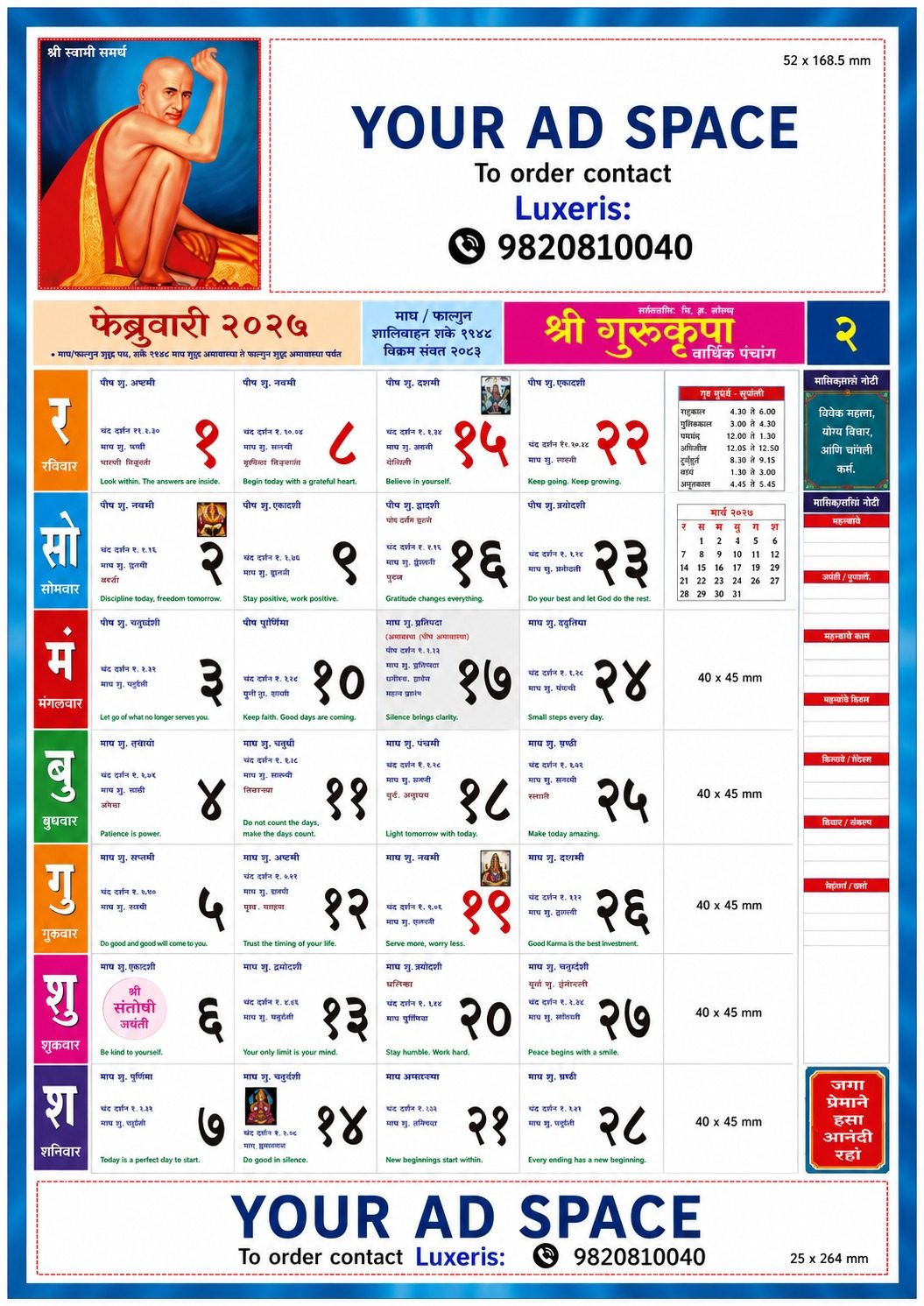
Every year, someone on a marketing team asks the same question: does anyone still use a wall calendar? The honest answer, if you're gifting in Mumbai and across Maharashtra, is yes — more than almost any other branded item you'll hand out this year.
Digital ads disappear the moment someone closes a tab. A branded pen sits in a drawer. But a calendar with a proper Marathi Panchang goes up on a wall, in a shop, in a kitchen, or beside a desk — and it stays there for all 365 days, seen every single morning by the person who hung it and everyone who walks past it.
Why calendars outlast almost every other gifting format
Most corporate gifts are used once, or occasionally, or quietly forgotten in a cupboard. A calendar is different because it has a job to do — people genuinely need to check the date, the tithi, the muhurat, or a festival. That daily utility is what keeps your branding in view long after the gifting season ends.
This is especially true in Maharashtra, where a Marathi Panchang calendar isn't treated as promotional material — it's treated as a household reference tool. Many families and small businesses keep the same calendar up the entire year specifically because of this.
What makes a 2027 corporate calendar actually effective
Not every calendar earns its wall space. Based on what we've seen work across hundreds of Mumbai businesses, a handful of details separate a calendar that gets used all year from one that gets tossed in January:
- Complete, accurate Panchang details — tithi, nakshatra, festivals and muhurat dates people can actually rely on, not a token afterthought.
- Genuinely readable print — large enough numerals and clear month blocks, especially for family or shop use where multiple people check it daily.
- Premium paper stock — a calendar printed on thin paper looks disposable within weeks. 100 GSM art paper or heavier holds up and reads as a considered gift, not a giveaway.
- Restrained branding placement — your logo and contact details in a clear, dedicated space rather than crowding the actual calendar grid. People keep calendars that don't feel like an ad.
- Early ordering — the best distribution window is Diwali through early January, which means production needs to be locked in well before that, not scrambled together in December.
Who this works best for
Corporate calendars perform particularly well for businesses with an ongoing relationship to maintain — not just a one-time transaction. A few patterns we see repeatedly:
- Dealers and distributors gifting to retail shop owners, where the calendar hangs in the shop itself and is seen by every customer who walks in.
- Insurance and finance businesses where a client remembering your name in October, six months after the policy was sold, has real value.
- Manufacturing and B2B suppliers maintaining recall with procurement teams and factory floor contacts across the year.
- Housing societies and local businesses building neighbourhood-level brand familiarity that compounds year after year.
Planning your 2027 order
The biggest mistake we see is treating calendar orders as a last-minute Diwali task. Production, especially for bulk orders with custom branding, needs lead time — for paper sourcing, Panchang typesetting, proofing your ad space, and print runs. Businesses that order in August or September get their calendars distributed well before the festive rush, while last-minute orders often arrive after the best gifting window has already closed.
If you're planning your 2027 gifting calendar (no pun intended), the practical move is to lock in quantity and branding details now, while there's still room to get proofs approved and adjustments made before the print run.
2027 Customised Yearly Calendars are open for order
100 GSM premium art paper, complete Marathi Panchang, and your branding on every sheet. Bulk orders from 300 pieces, quoted for Mumbai and pan-India delivery.
The bigger picture: gifting that earns its place
The underlying principle behind a good corporate calendar applies to corporate gifting generally — the gifts that actually build brand recall are the ones that fold into someone's everyday life, not the ones that shout the loudest on day one. A calendar just happens to be one of the most efficient examples: low cost per unit, a full year of visibility, and a place in the home or shop that few other gifts can claim.
If a calendar doesn't fit your gifting plan this year, the same thinking applies across executive gift sets, keychains and other everyday branded items — the goal is always utility first, branding second.